Sunday, March 10, 2013

Székelys and ethnic protests.

Yesterday there were demonstrations in Târgu Mureș.  There haven't been ethnic riots here since 1990 or so, but tensions between Hungarians and Romanians have been on the rise for the past few years, and so yesterday was a big day: an estimated 10,000 ethnic Hungarians (if not more) from all over the country came to Târgu Mureș and marched on the center, rallying for Hungarian autonomy in what's known as Székely land. 

Jack and I weren't quite sure what to do about the demonstrations.  We were in the same part of town for an English language church service, and we were curious to see -- though also wary of the possible dangers.  I've attended my fair share of protests in the U.S., and they've never been scary, but this had potential to be different, and we were very sobered by that fact.  Otilia, our host mom, was terrified to go outside yesterday afternoon, and bought two extra loaves of bread just in case the city closed down.  She said that in the 1989 revolution and ethnic riots that followed in 1990, shops were closed for a few days, and she wasn't allowed to buy bread from the Hungarian owners of the few bakeries that remained open -- she had to send her husband, who spoke a bit of Hungarian, to try and fool the owners into letting him buy bread.  She was afraid the same could happen again, so there in the cupboard they sat, visible markers of her fear that the past is repeating itself: two giant loaves of freshly-baked bread, just in case.  She said that twenty years ago the streets were blockaded so no one could get through by bus or car -- only on foot, and even that was dangerous, with the hoards of people, many of whom were from out of town.

It's the out-of-towners who made the people we talked to nervous.  In Târgu Mureș the population is about 50% Romanian and 50% Hungarian, and they seem to co-exist quite well, though of course tensions flare to the surface occasionally.  But Târgu Mureș is also seen as the central city for the Hungarian population of Romania, the majority of whom live in three districts: Mureș (where Târgu Mureș is located), Harghita, and Covasna.  In these districts there is actually a Hungarian majority, meaning that in some small isolated villages there, children grow up speaking only Hungarian, unable to communicate in Romanian at all.  These three provinces form the so-called Székely land.  There have been calls in the past from Hungarians in these districts for them to be autonomous -- either self-ruling or connected to Hungary (despite the fact that none of them are geographically on the border).  These same nationalistic demands are echoed by the Jobbik party inside Hungary (Jobbik is an extremely nationalistic, anti-Roma, anti-Semitic, "Hungarian purity" party that has gained much power in the Hungarian Parliament in recent years -- some call them neo-Nazis.  They would love to have "Greater Hungary" back, which includes Transylvania and parts of Slovakia... but that history deserves its own post).  Inside Romania, these demands for autonomy largely come from the Székelys, a subgroup of ethnic Hungarians who actually did have autonomous regions from 1952 to 1968, which were then abolished by Ceaușescu.  Our host mom Otilia adamantly declared yesterday that Hungarians are good people but that the Székelys are dangerous and troublemakers -- an interesting opinion to come from our gentle hostess, who also believes adamantly that people's common humanity should matter more than their nationality.  The demonstrations were supposed to bring in Székelys and Hungarian nationalists from around Romania.  It was a bit scary to consider the prospect of angry out-of-towners descending upon a city we have grown fond of, unconcerned for its wellbeing.  Hungarians from Târgu Mureș love this city too; they are good neighbors and active citizens and have to live here once the protest is over.  But those people who come in from out of town and don't have the same concern for this city, its welfare and its inhabitants -- that can be a bit scary. 

So yesterday we were on the lookout, curious as to what we'd see.  There had been police and jandarms (soldiers in the Romanian army) patrolling the streets the last few days in higher numbers than usual, especially in the center.  We woke up Sunday morning to overcast, rainy skies and a sense of foreboding throughout the city -- and yet life seemed to go on as normal, despite the common knowledge of what was to happen in the afternoon.  The police presence and the sense of wariness it created make me wonder what it must have been like to live here under Ceaușescu's authoritarian communist rule... but that's another post as well.  However, they seemed well-prepared, and we were praying hard for peace and productive conversation and understanding between the Hungarian demonstrators and any Romanian counter-protesters who showed up.

The march was supposed to start at 4pm and arrive in the center by 6pm or so.  Jack and I got to the center around 6:20, wandered for a while without seeing anything other than a hundred or so jandarms with helmets and nightsticks at the ready, and a small group of Romanian 20-something guys with Romanian flags draped over their shoulders, loitering and waiting for something to happen.  We ended up eating dinner at a restaurant downtown, watching, waiting, wondering.  And at about 7:15 they arrived: a huge line of demonstrators walking down the street through the center, waving Hungarian and Székely flags, carrying torches, singing patriotic anthems and chanting "Székelyföld! Székelyföld!" (Székely land) or "Autonómiá!" (autonomy).  It was a bit eery to see the Jobbik flag mixed in among the flags of the Székelys and Hungary -- nationalism is something I can start to wrap my head around (though being from the American cultural melting pot, even that is hard for me to really understand) -- but the fascist, anti-Semitic, anti-Roma, extreme nationalism of Jobbik sent shivers down my spine and makes me, quite frankly, angry.  

But for the most part, everything seemed peaceful -- at least until the time when we left, around 8pm.  The huge parade marched to the end of the center, gathered in a crowd around the Cultural Palace (a beautiful monument of Hungarian architecture), sang patriotic songs to the accompaniment of a brass band, and then slowly demonstrators walked away, boarding the enormous line of buses (at least 50) which would carry them back across Romania or Hungary to their hometowns.  When we left, the line of people was still marching through the center, with no end in sight -- it really was a huge demonstration.
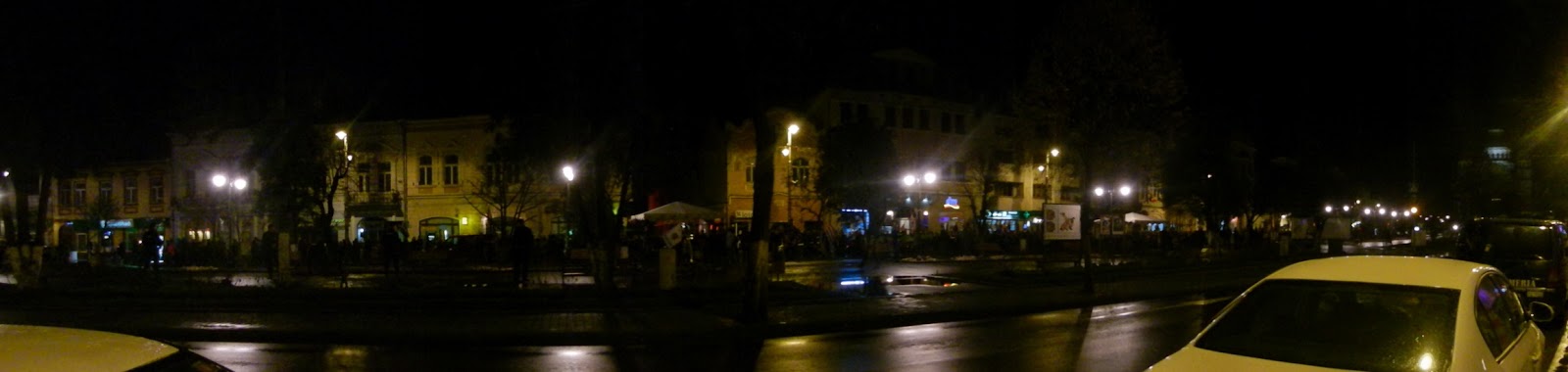
The line of protestors extended down the entire center, and they just kept coming...

 At the end of the marching route was a crowd of protestors: this is only a small glimpse.

 Marchers demanding autonomy.

We took the maxi taxi back home, catching it from a stop outside the center, since the roads through the center were blocked off by police and full of demonstrators.  As we boarded the maxi, a few older men who had been at the protest got on as well, carrying their Székely flags proudly in hand.  It was an interesting ride home, as the Hungarians on the maxi taxi talked openly but the Romanian speakers kept silent.  We all got off at the same stop, neighbors in Tudor -- but how strange it is to think that some of our neighbors want autonomy from this city, want legal and political freedom from the community of Târgu Mureș which seems so healthy and inclusive and well-functioning.  It was a bit disturbing, to be frank, particularly after seeing the Jobbik influence at the march.  But we got home safely, and today the police officers on our street corner are gone.  Life is back to normal... whatever that means.

We're praying that in the later hours of the night, yesterday's demonstrations remained peaceful.  We haven't yet heard otherwise, so we are optimistic about the civility of the whole affair.  But more than that, we even dare to pray that these demonstrations may have been productive and somehow led the conversation in the direction of reconciliation and peace.  Maybe it's a crazy thing to pray, when we know full well that resentment, hostility, and violence so often win the day, and that things are so unlikely to change -- but we believe in a crazy God who already defeated death and evil and is coming back to restore all things, so we dare to pray for this now.  And we'd love to have you pray with us.

Thursday, March 7, 2013

Here we are.

I have long held that ministry and the life of a missionary is not glamorous as we devote our lives to sharing in God's glory. The latest manifestation of this truth is in that Kelly and I have realized that if we don't have a specific life-giving event for about a day, we sink into a depression, and we begin to question why we're in Târgu Mureș when we really came here to be in Lupeni and work with FNO. We don't have that many friends here, and we have to make plans in advance, so we spend a lot of days and evenings just doing homework or making food or listening to Car Talk. It's fine, but is no replacement for good community. So why are we here? "Suntem aici doar să învățăm românește," is what we tell folks who ask us why we're here, if we're missionaries or working with orphans or what. We're just here to learn Romanian.

We've found that that isn't quite true.

Besides students, we're mainly companions for folks here--some new people for the Michmerhuizen boys to play with, CRC people for Steve and Jan to talk to (and them for us to talk to!), and English speakers for Daniel and Maria Edwards to be friends with. It's funny how necessity speeds up how quickly you get comfortable with people.

We also provide company and two young people for Otilia to mother now that she is the only one of her family left in this house. Sometime it really bugs us and makes us feel like children and that our well-deserved independence isn't being fully realized here. And then we say, "Oh, what Americans we are," and get on with it (though, this can take a day or a week to move on from sometimes). But it is good to live here, and to be her companion for three months. She asked us a week or so ago if there was any chance that we could do our work that we came to do in Târgu Mureș and not have to leave and go to Lupeni in April. We kind of looked at each other and explained that the FNO office is in Lupeni and VIATA is on Straja, so we have to go. We were called to Lupeni, to do specific work for them...

Which we were. And we are. But we are called above all other calls to follow the leading of the Holy Spirit wherever we are. And through the discernment of the faithful community around us, we are in Târgu Mureș until April. Sin is so great that even a call from God can be used as an excuse to not be present and thankful in our circumstances and loving to the people around us. Resentment builds too easily when we're not present, and resentment sucks the love out of our lives. And considering that we came to these people on a specific call from God, it doesn't do well to represent our Creator and Caller by being sullen about being where we are. I think that everyone else really loves it that we're here (or is at least pleasantly tolerant of us).

We thank God that we are honest with each other and have talked through our emotions and can call each other out when we're sinking into resentment.

I'm not worried when we feel unhappy about being here, because I also feel unhappy that Jesus is not back here on earth, bringing the Kingdom in full. Call me a pessimist if you like, but I'm truly unhappy that we have to experience the "not yet" of the Kingdom. Now, I am totally thankful that Jesus sent the Holy Spirit to counsel and guide the Church in this in-between time, and I am totally thankful that the Holy Spirit has led Kelly and me to give company to Otilia and Daniel and Maria while we're not doing FNO work or rock climbing in the Jiu Valley.

If the sounds a bit like some Lenten longings, your ears are attuned. A dear friend has suggested that we approach the three months in Târgu Mureș as a fast, as a time of Lenten longing, to be in Lupeni, and for the Kingdom to come fully. Nothing makes the "not yet" of the Kingdom more real than the "not yet" of something else, whether that be food in your belly, being married AT LAST, or being in a place you love with people you love doing work that you love, that you were called to do.

Please understand that we are content and peaceful in Târgu Mureș. We have tasted the life in Lupeni and long for it, so that makes it difficult to stay fully present here. In The Hiding Place, Corrie is worried that her aunt complains about living with them and longs to be back in her last governess job with "those wonderful children." Her mother tells her that when her aunt was at that job, all she longed for was the previous job and "those wonderful children." She tells Corrie that happiness is not something that emits from your circumstances so much as how your heart is attuned to receive those circumstances. Corrie and her sister Betsy manage to find joy in a flea-infested barracks at a forced labor camp by being thankful in all circumstances, just like the apostle Paul says.

Pray, friends. Not just for us, but for yourselves, your families, your neighbors. I think a lot of problems would begin to be solved if folks decided to be present and accept their circumstances, and be thankful in spite of not having all their wants and dreams satisfied RIGHT NOW. Reach out to God who is right with us in every circumstance. Just affirm His presence, and those circumstances suddenly seem brighter.     

Wednesday, March 6, 2013

The maxi taxi.

Today, for those of you who have never had the opportunity to experience one for yourself, I am going to introduce you to the maxi taxi.  It's a daily fixture of our life in Romania, so I figured it deserved a mention here.


In Târgu Mureș, there are two options for public transit: the bus or the maxi.  Autobuzuri are like public buses in any large city in any country.  Maxi taxis, however, are different from anything I've seen in the States.  A maxi taxi is a large van -- think 15-passenger size -- that's been outfitted to seat 16 people and hold another 20 standing in the aisle.  They're not usually that full, but sometimes they are.  Oh, sometimes they are much more full.

For instance, once Jack and I rode the free maxi taxi to Auchan.  Typically it costs 2 lei per ride, which is the equivalent of about 60 cents in American dollars.  However, a few of the enormous international supermarket chains here have free maxi taxis for customers, which roam the city picking up anyone who wants a free ride to the outskirts of town, where these monolithic shopping malls are.  We had heard that you could buy tortillas at Auchan, and we were curious, so we got on.

Big mistake.  Notice how in the picture above, there are a few people sitting down, looking pleasantly out the window, and you only see one person standing with his or her rear squashed against the window?  That's nice.  But in some maxi taxis at some hours of the day -- and in the free maxi taxis at all hours of the day -- the vehicle is standing room only, so upon boarding you are suddenly face-to-face with a complete stranger who is only inches away, while another stranger is unfortunately smooshed between your rear and the window.  It's bearable while you're moving, because even the jerkiest of gear changes are softened by the mass of humanity swaying back and forth, all smushed together.  The American pop music on the radio, the smells of everyone's breath and laundry detergent... it's a unique, but not necessarily altogether unpleasant, experience.  But when someone has to get off at a stop, it's not so nice.  It seems inevitable that at least one of the people who needs to get down at each stop is standing in the far back of the maxi taxi, and you can only imagine the chaos of trying to make your way down the aisle and out the door of a 15-passenger van with 37 people in it.  Sometimes I think it would be easier if we'd just lift them up and crowd-surf them to the door, but I don't know how to offer that suggestion in Romanian yet.

Yet the thing which has interested me most about maxi taxis and the culture associated with them is the method of boarding.  Typically, when a maxi comes to a stop, the people who are exiting get off first and leave the door open for those boarding; the last person on then pulls the door shut behind them.  But just because the people getting on the maxi taxi wait for those getting off to step down doesn't mean they leave room for them to do so.  Romanians generally have a much smaller personal space "bubble" than Americans, so people stand closer together in line, when talking, in a crowd, and so on.  (Often I have been waiting at a store counter, thinking I am next, when a Romanian will cut right in front of me without realizing -- certainly not intending to be rude, but to them I didn't appear to be in line.)  This translates to maxi taxis too: exiting one is like pushing your way through a mob, since people rarely leave a path for the departing riders to walk through, instead crowding immediately to the door.  At Auchan, catching the maxi taxi back into the city was like being part of a swarm of pigeons swooping in to freshly-thrown bread crumbs.  (If you've never seen pigeons dive-bomb bread crumbs, it's astonishing.  Try it.)  Jack and I simply stood back in amazement and had to laugh to ourselves a bit -- but then, of course, we joined the throng and stood wrapped tightly in each other's arms among a swaying, sweaty, crowded mass of humanity, all the way back home.

I love riding the maxi.  I really, truly do.

Monday, March 4, 2013

Marțisor.

March 1st was Marțisor, the Romanian holiday celebrating the coming of spring!  It's a delightful little holiday, and for those of you still battling blizzards in the American Midwest, I'm sorry to rub it in -- but spring seems to have sprung here.  It's sunny and fairly warm, and today I even saw flowers poking their heads above ground.

Historically, Marțisor has always been marked by the giving of little talismans or decorative brooches or bracelets, usually red and white and often with a little bead or stone or decorative ladybug charm or some similar festive springtime icon.  It's tradition to wear the red and white string all month, on your wrist or pinned on your jacket, and at the end of the month to tie it to a tree, thus (as the legend goes) imparting on that tree health and vitality for the upcoming year.  Now people buy and share Marțisor bracelets and tassels with their friends (though it's mostly women and children who do it).  The few days preceding Marțisor in Târgu Mureș were fun, as white tents popped up all over town with vendors selling fresh flowers and Marțisor trinkets of every variety.

 The centru of Târgu Mureș, filled with Marțisor booths.
 
 The lovely Marțisor pendant Jack gave me...

We bought one for Otilia and Jack surprised me with one too, which I already have forgotten to wear every day... oops.  Clearly I'm not a true Romanian.  But I'm excited to tie it to a tree at the end of the month, and I don't think I'll forget that part!  In the meantime, here are a few more pictures, which I did not take -- but they give a good feel for what the Marțisor decorations are like.  If you're interested in learning more, the Wikipedia article on Marțisor is actually pretty good... check it out!  And a happy coming-of-spring to you.


Tuesday, February 26, 2013

Packages.

We got our first packages today!

Here in Târgu Mureș, we really have access to pretty much anything we could want.  Romania's transition from communism to capitalism has resulted in a pretty open-armed embrace of commercialism and consumption (in large part, though of course there are pockets of dissent, like the "Shop less, live more" graffiti by our apartment).  But in Târgu Mureș alone we have access to three huge multinational grocery chains where we can buy food products ranging from Vietnamese rice paper wrappers to Philadelphia cream cheese.  Jack and I tend to avoid those stores, unless we've really got a craving -- they're not near the places we live and study, they're expensive and crowded, and quite frankly, we just prefer shopping at the tiny mom-and-pop shops on the street near our apartment, the farmers' market, and little hole-in-the-wall stores downtown.

But anyway, shopping habits aside: there are a few things we haven't been able to find here, no matter how hard we've looked.  Namely cumin, Reese's peanut butter cups, and brown sugar.  (We didn't realize how often we used cumin until we came here and started to cook without it!)  So our moms, being the loving and committed and wonderful people that they are, decided to mail them to us.  The packages left the States on the 11th and arrived in Romania on the 19th; we were given notice by the post office of their arrival on the 21st; and today, the 26th, we went to pick them up.  (In Târgu Mureș you can only pick up packages from overseas on Tuesdays and Thursdays from 9am to 2pm.)

We had been warned by a friend that the office was a bit hard to find and that, upon arrival, we might be slightly interrogated (in Romanian), so we practiced possible vocabulary, looked at maps, brought our passports, and prepared for lots of confusion.  The post office where packages are delivered is on the far side of town from where we live (there are multiple post offices in the city, but out-of-Europe packages only come to one of them).  We took the bus, found the post office, walked around back to what looked like an unmarked delivery dock, pulled open a rusting metal door, and stepped into a tiny office, where a small group of people were clustered around a desk, mailing and receiving their packages.

Thankfully, our transaction was easy.  We handed the guy our notice and, after a few questions, he got the boxes for us.  Because our packages were gifts, we didn't have to pay to pick them up (if you order something online, for example, you have to show your proof of purchase and pay a customs tax before they let you have your package).  We had to explain that we had two boxes because one was from each of our moms, which made the people behind the counter chuckle a bit.  But after only ten minutes or so, we walked out triumphant, a box under each arm, grinning in anticipation of burritos and peanut butter cookies and Reese's to share with our friends here.

Thanks, moms.

Monday, February 25, 2013

Friends, birthdays, travel, and skiing.

Jack and I have been traveling a bit lately, so sorry for the neglect of the blog.  We'll try to play a bit of catch-up in the next few days, as a number of interesting things have happened and made us ponder.  But for now, a few pictures and tales from our latest adventure!

On Valentine's Day, we took the bus from Târgu Mureș to Cluj, Romania's second-largest city which is about two hours west.  Cluj is a gorgeous city with a well-maintained historic center, a hub for higher education and fine arts in the country.  FNO has an office there, because there are dozens and dozens of IMPACT clubs in the Cluj area, and they typically send a lot of kids to the Viața camp in the summer, too -- so we'd been wanting to visit, meet the FNO staff, and do a bit of exploring.  Plus, my dear friend Alyssa was coming in to Cluj by train on the night of the 14th so we could spend a long weekend together before she flew back home to the States.  So many good reasons to go!

Look at what we found in Cluj!

We picked Alyssa up at the train station late on the night of the 14th, wandered back to our cool hostel in the old city wall (yeah!), and then left early on the morning of the 15th to take the bus down to Lupeni for the rest of the weekend.  Traveling by bus in Romania is easy, and for us has thus far proved to be faster, cheaper, and more convenient than train -- so we were happy to throw our bags under the bus and settle into its comfortable seats for the six-hour journey south to the mountains.

And what a lovely weekend we had.  It was my 23rd birthday on the 18th, so our time in Lupeni was full of fun surprises from Jack and Alyssa and the dear friends we have in Lupeni: a day of skiing on Straja, the mountain which towers over Lupeni; an evening of making crafts to make our home cozy (Jack knew exactly what I wanted!); an afternoon at the Bates' with not one but two surprise birthday desserts; and on our last night together before Alyssa flew out (in Cluj again), a fabulous Indian dinner at a hole-in-the-wall restaurant at which we and a food reviewer were the only patrons.  We got to meet Felipe and Janelle, the other young couple who have just moved to Lupeni and are also committed to at least three years with FNO, and a number of other wonderful people -- we are so excited to move back to the Jiu Valley in April and be a part of that community!  But more on that later.

Alyssa and Kelly and a lot of tasty Indian food.

 Brandi, Briana, and Gabe's fabulous birthday creations: carob cake with apple and quince
 and berry muffins -- all from Lupeni's summer bounty.

Skiing deserves a bit more attention than the passing mention in the previous paragraph.  I grew up cross-country skiing with my family in Iowa, but habitually fell down when I attempted to go down hills, which didn't seem to bode well for picking up the downhill version of the sport.  I'd only downhill skiied once in my life, and that was three and a half years ago, in Michigan, where there aren't very imposing mountains.  Jack had never skiied in his life.  But Alyssa's really good, so we decided to go -- and it was, well, entertaining.

We took this picture before we started, hence the not-covered-in-snow thing.

I should preface this by saying that Alyssa was a fabulous and patient teacher.  She would nicely wait and watch from behind as Jack and I gingerly snowplowed our way down the slope, then swoop up gracefully when we nosedived into the snow and only laugh a little bit as she helped pull us back upright.  At least at first.  Eventually she decided to meet us at the bottom and then stood there taking video of us while we tottered and toppled our way to the end... what a good friend.  (I've thought about posting that video here, because it's actually really hilarious, but I think the internet is too slow here for that to work.  Thankfully.)  But in our defense, the bottom of the slope we were on (and yes, we were too chicken to ski any more than just the one same hill over and over) was icy and steep and there was a huge line of skiers standing at the bottom waiting to get on the lift, and I was terrified of crashing into them.  Alyssa promised I'd be able to stop before I hit anyone, but I wasn't willing to take the chance... so I fell down with 100 meters to go, just to be safe.

Jack and Kelly learn to snowplow...

 The bottom of the hill = huge line of skiers waiting for the lift.

I've never skied in Colorado or the Alps or anywhere fancy, but I can presume it's different in Romania.  For one thing, Straja is a crowded little village where the roads aren't plowed and the sidewalks (if they exist) aren't shoveled -- which means that everyone is tromping awkwardly in their ski boots through six-inch-deep brown slush, carrying skis and poles and trying not to fall down.  It's crowded, and loud techno music is constantly booming from the cabanas, and there are stray dogs all over (who sometimes chase the skiers as they approach the bottom of the hill, joyfully leaping alongside and barking and nipping at their poles).  On the Saturday we visited, the lines were long and the hills were packed.  There had been a children's ski competition that morning, which had as its logo and mascot Baloo the Bear, an old bear who lives in a cage just behind the ski cabanas on Straja.  You can go visit him -- I think the ski competition was supposed to be in celebration of his birthday, so it involved all the children trooping down to his cage, singing happy birthday, and then feeding the bear a cake.  Strange.

This is the village of Straja.  When it's cloudy, you can't even see the valley below.

But for all the chaos and confusion of trying to rent skis and buy lift tickets and negotiate the crowds and learn to master (ha) a new winter sport, we had a wonderful, wonderful time.  At the end of the afternoon we happily sipped mulled wine and ate giant, delicious Hungarian pastries (basically pastry dough wrapped around a giant broomstick, roasted over a fire until baked, then rolled in sugar and walnuts or cinnamon or coconut and eaten warm).  Then we took the gondola back down to the valley, walked fifteen minutes, and were home in Apartment Lucy, counting our blessings to live in such an amazing and beautiful place with such dear and wonderful people.

Post-skiing snacks should always be fresh off the fire...

Relieved to be on the way home without any broken bones, happy and tired.

Home sweet home: Lupeni at the bottom of the gondola.

Lovely.

Tuesday, February 12, 2013

Yum.

Lately our lives have been full of good food.  And though usually this blog is full of words and musings about things more complicated than food, I'm a big fan of eating, so I want to share some of these culinary delights!  I think I'm even going to break the general code of black-and-white photography on this blog to share pictures... they were that yummy.

To wax philosophical for a second, I think food is one of those great, universal things which bring people together.  After all, everybody eats, and eating is fun.  In every culture I've ever experienced, food is an essential part of hospitality and celebration.  Feast days and holidays are universal, and everyone loves them... well, at least I do!  So living in a culture where food is an essential part of hospitality and where local and home-prepared food are valued parts of the rhythm of life?  I love it.

Otilia, our host here in Târgu Mureș, loves food too.  (We're kindred spirits that way.)  She told us a few weeks ago that Sundays are the day for church and special "Sunday food," and we've been living that up.  One week she made "Varza la Cluj," which is sorta like a Romanian casserole with ground pork, rice, cabbage, spices, and smântâna (the ever-present Romanian sour cream), followed by dessert of homemade crepes with homemade plum jam.  Yum.  The next week was sarmale, the Romanian national dish -- little cabbage rolls stuffed with, you guessed it!  Pork, rice, and spices. 

 I didn't take this picture... but here are the famous sarmale!

This week she made pork șnițel (flattened, battered, fried pork chops) with mashed potatoes with smântâna and a side of homemade pickled tomatoes and cucumbers.  We followed all that with gogoși, or Romanian donuts... they just sound fancier by their Romanian name.

Making gogoși with Otilia was delightful.  She'd made the dough before church and let it rise all morning, so that when we got home we could simply roll it out and cut it into circles with a coffee mug.  You then drop the little doughy circles into sizzling sunflower oil, let them puff up and fry, and then scoop them out.  Once cooled, you top or fill them with accessories of your choice: chocolate spreads, jams and jellies, cheese... endless possibilities.  They're not as good the next day, so Jack and I each ate, like, five.  But it was worth it.  As you can see.

Cutting the dough into donut shapes...

Frying them in oil...

And delight!  I think the best way to eat gogoși is with jam AND chocolate...

So Otilia's a great cook, and our weeks here are filled with soups, bread, potatoes, vegetables, and all the hearty, healthy delight of Romanian cooking.  But we do some of our own meal preparation too, which has been a source of amusement to Otilia, who marvels at the strange things we make.  Last night we got ambitious and made spring rolls with peanut sauce, after the delightful discovery of peanut butter, rice paper, and rice noodles at a big grocery store here.  She laughed at them, calling them "strange Vietnamese sarmale," but ultimately sat down and enjoyed them with us.  Success.