
We got our first packages today!
Here in Târgu Mureș, we really have access to pretty much anything we could want. Romania's transition from communism to capitalism has resulted in a pretty open-armed embrace of commercialism and consumption (in large part, though of course there are pockets of dissent, like the "Shop less, live more" graffiti by our apartment). But in Târgu Mureș alone we have access to three huge multinational grocery chains where we can buy food products ranging from Vietnamese rice paper wrappers to Philadelphia cream cheese. Jack and I tend to avoid those stores, unless we've really got a craving -- they're not near the places we live and study, they're expensive and crowded, and quite frankly, we just prefer shopping at the tiny mom-and-pop shops on the street near our apartment, the farmers' market, and little hole-in-the-wall stores downtown.
But anyway, shopping habits aside: there are a few things we haven't been able to find here, no matter how hard we've looked. Namely cumin, Reese's peanut butter cups, and brown sugar. (We didn't realize how often we used cumin until we came here and started to cook without it!) So our moms, being the loving and committed and wonderful people that they are, decided to mail them to us. The packages left the States on the 11th and arrived in Romania on the 19th; we were given notice by the post office of their arrival on the 21st; and today, the 26th, we went to pick them up. (In Târgu Mureș you can only pick up packages from overseas on Tuesdays and Thursdays from 9am to 2pm.)
We had been warned by a friend that the office was a bit hard to find and that, upon arrival, we might be slightly interrogated (in Romanian), so we practiced possible vocabulary, looked at maps, brought our passports, and prepared for lots of confusion. The post office where packages are delivered is on the far side of town from where we live (there are multiple post offices in the city, but out-of-Europe packages only come to one of them). We took the bus, found the post office, walked around back to what looked like an unmarked delivery dock, pulled open a rusting metal door, and stepped into a tiny office, where a small group of people were clustered around a desk, mailing and receiving their packages.
Thankfully, our transaction was easy. We handed the guy our notice and, after a few questions, he got the boxes for us. Because our packages were gifts, we didn't have to pay to pick them up (if you order something online, for example, you have to show your proof of purchase and pay a customs tax before they let you have your package). We had to explain that we had two boxes because one was from each of our moms, which made the people behind the counter chuckle a bit. But after only ten minutes or so, we walked out triumphant, a box under each arm, grinning in anticipation of burritos and peanut butter cookies and Reese's to share with our friends here.
Thanks, moms.
Tuesday, February 26, 2013

Monday, February 25, 2013
Friends, birthdays, travel, and skiing.
Jack and I have been traveling a bit lately, so sorry for the neglect of the blog. We'll try to play a bit of catch-up in the next few days, as a number of interesting things have happened and made us ponder. But for now, a few pictures and tales from our latest adventure!
On Valentine's Day, we took the bus from Târgu Mureș to Cluj, Romania's second-largest city which is about two hours west. Cluj is a gorgeous city with a well-maintained historic center, a hub for higher education and fine arts in the country. FNO has an office there, because there are dozens and dozens of IMPACT clubs in the Cluj area, and they typically send a lot of kids to the Viața camp in the summer, too -- so we'd been wanting to visit, meet the FNO staff, and do a bit of exploring. Plus, my dear friend Alyssa was coming in to Cluj by train on the night of the 14th so we could spend a long weekend together before she flew back home to the States. So many good reasons to go!

We picked Alyssa up at the train station late on the night of the 14th, wandered back to our cool hostel in the old city wall (yeah!), and then left early on the morning of the 15th to take the bus down to Lupeni for the rest of the weekend. Traveling by bus in Romania is easy, and for us has thus far proved to be faster, cheaper, and more convenient than train -- so we were happy to throw our bags under the bus and settle into its comfortable seats for the six-hour journey south to the mountains.
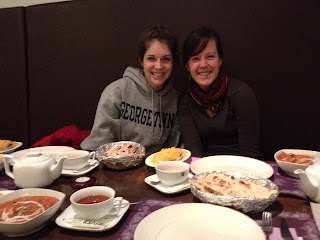
And what a lovely weekend we had. It was my 23rd birthday on the 18th, so our time in Lupeni was full of fun surprises from Jack and Alyssa and the dear friends we have in Lupeni: a day of skiing on Straja, the mountain which towers over Lupeni; an evening of making crafts to make our home cozy (Jack knew exactly what I wanted!); an afternoon at the Bates' with not one but two surprise birthday desserts; and on our last night together before Alyssa flew out (in Cluj again), a fabulous Indian dinner at a hole-in-the-wall restaurant at which we and a food reviewer were the only patrons. We got to meet Felipe and Janelle, the other young couple who have just moved to Lupeni and are also committed to at least three years with FNO, and a number of other wonderful people -- we are so excited to move back to the Jiu Valley in April and be a part of that community! But more on that later.

Skiing deserves a bit more attention than the passing mention in the previous paragraph. I grew up cross-country skiing with my family in Iowa, but habitually fell down when I attempted to go down hills, which didn't seem to bode well for picking up the downhill version of the sport. I'd only downhill skiied once in my life, and that was three and a half years ago, in Michigan, where there aren't very imposing mountains. Jack had never skiied in his life. But Alyssa's really good, so we decided to go -- and it was, well, entertaining.

I should preface this by saying that Alyssa was a fabulous and patient teacher. She would nicely wait and watch from behind as Jack and I gingerly snowplowed our way down the slope, then swoop up gracefully when we nosedived into the snow and only laugh a little bit as she helped pull us back upright. At least at first. Eventually she decided to meet us at the bottom and then stood there taking video of us while we tottered and toppled our way to the end... what a good friend. (I've thought about posting that video here, because it's actually really hilarious, but I think the internet is too slow here for that to work. Thankfully.) But in our defense, the bottom of the slope we were on (and yes, we were too chicken to ski any more than just the one same hill over and over) was icy and steep and there was a huge line of skiers standing at the bottom waiting to get on the lift, and I was terrified of crashing into them. Alyssa promised I'd be able to stop before I hit anyone, but I wasn't willing to take the chance... so I fell down with 100 meters to go, just to be safe.


I've never skied in Colorado or the Alps or anywhere fancy, but I can presume it's different in Romania. For one thing, Straja is a crowded little village where the roads aren't plowed and the sidewalks (if they exist) aren't shoveled -- which means that everyone is tromping awkwardly in their ski boots through six-inch-deep brown slush, carrying skis and poles and trying not to fall down. It's crowded, and loud techno music is constantly booming from the cabanas, and there are stray dogs all over (who sometimes chase the skiers as they approach the bottom of the hill, joyfully leaping alongside and barking and nipping at their poles). On the Saturday we visited, the lines were long and the hills were packed. There had been a children's ski competition that morning, which had as its logo and mascot Baloo the Bear, an old bear who lives in a cage just behind the ski cabanas on Straja. You can go visit him -- I think the ski competition was supposed to be in celebration of his birthday, so it involved all the children trooping down to his cage, singing happy birthday, and then feeding the bear a cake. Strange.

But for all the chaos and confusion of trying to rent skis and buy lift tickets and negotiate the crowds and learn to master (ha) a new winter sport, we had a wonderful, wonderful time. At the end of the afternoon we happily sipped mulled wine and ate giant, delicious Hungarian pastries (basically pastry dough wrapped around a giant broomstick, roasted over a fire until baked, then rolled in sugar and walnuts or cinnamon or coconut and eaten warm). Then we took the gondola back down to the valley, walked fifteen minutes, and were home in Apartment Lucy, counting our blessings to live in such an amazing and beautiful place with such dear and wonderful people.


Lovely.
On Valentine's Day, we took the bus from Târgu Mureș to Cluj, Romania's second-largest city which is about two hours west. Cluj is a gorgeous city with a well-maintained historic center, a hub for higher education and fine arts in the country. FNO has an office there, because there are dozens and dozens of IMPACT clubs in the Cluj area, and they typically send a lot of kids to the Viața camp in the summer, too -- so we'd been wanting to visit, meet the FNO staff, and do a bit of exploring. Plus, my dear friend Alyssa was coming in to Cluj by train on the night of the 14th so we could spend a long weekend together before she flew back home to the States. So many good reasons to go!

Look at what we found in Cluj!
We picked Alyssa up at the train station late on the night of the 14th, wandered back to our cool hostel in the old city wall (yeah!), and then left early on the morning of the 15th to take the bus down to Lupeni for the rest of the weekend. Traveling by bus in Romania is easy, and for us has thus far proved to be faster, cheaper, and more convenient than train -- so we were happy to throw our bags under the bus and settle into its comfortable seats for the six-hour journey south to the mountains.
And what a lovely weekend we had. It was my 23rd birthday on the 18th, so our time in Lupeni was full of fun surprises from Jack and Alyssa and the dear friends we have in Lupeni: a day of skiing on Straja, the mountain which towers over Lupeni; an evening of making crafts to make our home cozy (Jack knew exactly what I wanted!); an afternoon at the Bates' with not one but two surprise birthday desserts; and on our last night together before Alyssa flew out (in Cluj again), a fabulous Indian dinner at a hole-in-the-wall restaurant at which we and a food reviewer were the only patrons. We got to meet Felipe and Janelle, the other young couple who have just moved to Lupeni and are also committed to at least three years with FNO, and a number of other wonderful people -- we are so excited to move back to the Jiu Valley in April and be a part of that community! But more on that later.

Alyssa and Kelly and a lot of tasty Indian food.

Brandi, Briana, and Gabe's fabulous birthday creations: carob cake with apple and quince
and berry muffins -- all from Lupeni's summer bounty.
Skiing deserves a bit more attention than the passing mention in the previous paragraph. I grew up cross-country skiing with my family in Iowa, but habitually fell down when I attempted to go down hills, which didn't seem to bode well for picking up the downhill version of the sport. I'd only downhill skiied once in my life, and that was three and a half years ago, in Michigan, where there aren't very imposing mountains. Jack had never skiied in his life. But Alyssa's really good, so we decided to go -- and it was, well, entertaining.

We took this picture before we started, hence the not-covered-in-snow thing.
I should preface this by saying that Alyssa was a fabulous and patient teacher. She would nicely wait and watch from behind as Jack and I gingerly snowplowed our way down the slope, then swoop up gracefully when we nosedived into the snow and only laugh a little bit as she helped pull us back upright. At least at first. Eventually she decided to meet us at the bottom and then stood there taking video of us while we tottered and toppled our way to the end... what a good friend. (I've thought about posting that video here, because it's actually really hilarious, but I think the internet is too slow here for that to work. Thankfully.) But in our defense, the bottom of the slope we were on (and yes, we were too chicken to ski any more than just the one same hill over and over) was icy and steep and there was a huge line of skiers standing at the bottom waiting to get on the lift, and I was terrified of crashing into them. Alyssa promised I'd be able to stop before I hit anyone, but I wasn't willing to take the chance... so I fell down with 100 meters to go, just to be safe.

Jack and Kelly learn to snowplow...

The bottom of the hill = huge line of skiers waiting for the lift.
I've never skied in Colorado or the Alps or anywhere fancy, but I can presume it's different in Romania. For one thing, Straja is a crowded little village where the roads aren't plowed and the sidewalks (if they exist) aren't shoveled -- which means that everyone is tromping awkwardly in their ski boots through six-inch-deep brown slush, carrying skis and poles and trying not to fall down. It's crowded, and loud techno music is constantly booming from the cabanas, and there are stray dogs all over (who sometimes chase the skiers as they approach the bottom of the hill, joyfully leaping alongside and barking and nipping at their poles). On the Saturday we visited, the lines were long and the hills were packed. There had been a children's ski competition that morning, which had as its logo and mascot Baloo the Bear, an old bear who lives in a cage just behind the ski cabanas on Straja. You can go visit him -- I think the ski competition was supposed to be in celebration of his birthday, so it involved all the children trooping down to his cage, singing happy birthday, and then feeding the bear a cake. Strange.

This is the village of Straja. When it's cloudy, you can't even see the valley below.
But for all the chaos and confusion of trying to rent skis and buy lift tickets and negotiate the crowds and learn to master (ha) a new winter sport, we had a wonderful, wonderful time. At the end of the afternoon we happily sipped mulled wine and ate giant, delicious Hungarian pastries (basically pastry dough wrapped around a giant broomstick, roasted over a fire until baked, then rolled in sugar and walnuts or cinnamon or coconut and eaten warm). Then we took the gondola back down to the valley, walked fifteen minutes, and were home in Apartment Lucy, counting our blessings to live in such an amazing and beautiful place with such dear and wonderful people.

Post-skiing snacks should always be fresh off the fire...

Relieved to be on the way home without any broken bones, happy and tired.

Home sweet home: Lupeni at the bottom of the gondola.
Lovely.
Tuesday, February 12, 2013
Yum.
Lately our lives have been full of good food. And though usually this blog is full of words and musings about things more complicated than food, I'm a big fan of eating, so I want to share some of these culinary delights! I think I'm even going to break the general code of black-and-white photography on this blog to share pictures... they were that yummy.
To wax philosophical for a second, I think food is one of those great, universal things which bring people together. After all, everybody eats, and eating is fun. In every culture I've ever experienced, food is an essential part of hospitality and celebration. Feast days and holidays are universal, and everyone loves them... well, at least I do! So living in a culture where food is an essential part of hospitality and where local and home-prepared food are valued parts of the rhythm of life? I love it.
Otilia, our host here in Târgu Mureș, loves food too. (We're kindred spirits that way.) She told us a few weeks ago that Sundays are the day for church and special "Sunday food," and we've been living that up. One week she made "Varza la Cluj," which is sorta like a Romanian casserole with ground pork, rice, cabbage, spices, and smântâna (the ever-present Romanian sour cream), followed by dessert of homemade crepes with homemade plum jam. Yum. The next week was sarmale, the Romanian national dish -- little cabbage rolls stuffed with, you guessed it! Pork, rice, and spices.

This week she made pork șnițel (flattened, battered, fried pork chops) with mashed potatoes with smântâna and a side of homemade pickled tomatoes and cucumbers. We followed all that with gogoși, or Romanian donuts... they just sound fancier by their Romanian name.
Making gogoși with Otilia was delightful. She'd made the dough before church and let it rise all morning, so that when we got home we could simply roll it out and cut it into circles with a coffee mug. You then drop the little doughy circles into sizzling sunflower oil, let them puff up and fry, and then scoop them out. Once cooled, you top or fill them with accessories of your choice: chocolate spreads, jams and jellies, cheese... endless possibilities. They're not as good the next day, so Jack and I each ate, like, five. But it was worth it. As you can see.


So Otilia's a great cook, and our weeks here are filled with soups, bread, potatoes, vegetables, and all the hearty, healthy delight of Romanian cooking. But we do some of our own meal preparation too, which has been a source of amusement to Otilia, who marvels at the strange things we make. Last night we got ambitious and made spring rolls with peanut sauce, after the delightful discovery of peanut butter, rice paper, and rice noodles at a big grocery store here. She laughed at them, calling them "strange Vietnamese sarmale," but ultimately sat down and enjoyed them with us. Success.
To wax philosophical for a second, I think food is one of those great, universal things which bring people together. After all, everybody eats, and eating is fun. In every culture I've ever experienced, food is an essential part of hospitality and celebration. Feast days and holidays are universal, and everyone loves them... well, at least I do! So living in a culture where food is an essential part of hospitality and where local and home-prepared food are valued parts of the rhythm of life? I love it.
Otilia, our host here in Târgu Mureș, loves food too. (We're kindred spirits that way.) She told us a few weeks ago that Sundays are the day for church and special "Sunday food," and we've been living that up. One week she made "Varza la Cluj," which is sorta like a Romanian casserole with ground pork, rice, cabbage, spices, and smântâna (the ever-present Romanian sour cream), followed by dessert of homemade crepes with homemade plum jam. Yum. The next week was sarmale, the Romanian national dish -- little cabbage rolls stuffed with, you guessed it! Pork, rice, and spices.
I didn't take this picture... but here are the famous sarmale!
This week she made pork șnițel (flattened, battered, fried pork chops) with mashed potatoes with smântâna and a side of homemade pickled tomatoes and cucumbers. We followed all that with gogoși, or Romanian donuts... they just sound fancier by their Romanian name.
Making gogoși with Otilia was delightful. She'd made the dough before church and let it rise all morning, so that when we got home we could simply roll it out and cut it into circles with a coffee mug. You then drop the little doughy circles into sizzling sunflower oil, let them puff up and fry, and then scoop them out. Once cooled, you top or fill them with accessories of your choice: chocolate spreads, jams and jellies, cheese... endless possibilities. They're not as good the next day, so Jack and I each ate, like, five. But it was worth it. As you can see.
Cutting the dough into donut shapes...
Frying them in oil...
And delight! I think the best way to eat gogoși is with jam AND chocolate...
So Otilia's a great cook, and our weeks here are filled with soups, bread, potatoes, vegetables, and all the hearty, healthy delight of Romanian cooking. But we do some of our own meal preparation too, which has been a source of amusement to Otilia, who marvels at the strange things we make. Last night we got ambitious and made spring rolls with peanut sauce, after the delightful discovery of peanut butter, rice paper, and rice noodles at a big grocery store here. She laughed at them, calling them "strange Vietnamese sarmale," but ultimately sat down and enjoyed them with us. Success.
Thursday, February 7, 2013
Life together.
Currently, Jack and I live in apartment 15, bloc 3, of Stradă Sârguințeii in Târgu Mureș, Romania. Every day we climb up five flights of stairs after class and then stand, panting, to unlock the heavy wooden door to our home. The building is quite nice, especially compared to our building in Lupeni, though it looks like a towering concrete monolith just like the rest of Romania's blocs -- just this one is mercifully free of decay. We live with an older woman named Otilia and a dental student named Georgiana, who also rents a room. As we've mentioned before, Otilia is a lovely lady, a recent widow who has taken in boarders so she doesn't have to live alone. We like her a lot, and are enjoying the give-and-take of teaching each other our respective languages, the laughter and confusion of complete misunderstanding, the sharing of meals and stories, and the gradual learning of life together.
But oh, life together... what a feat that is.
Personally, I am enough of an extrovert that most of the time I enjoy living with a host grandma, trying to talk with her, listening to her go off on tangents in Romanian for thirty minutes over dinner. We're learning more and more every day, and it's fun to realize that we're having real conversations now, about real things! We talk about cars and driving (she has an old white Dacia, but only her husband knew how to drive it), about communism and gardening (under the regime food production was stifled by the state, so even gardening could be seen as an underground activity), about death and marriage and her grief for her husband (he passed away just last June), and about the bizarre things we do to American food (last night I made cookie dough brownies, if that helps explain).
Otilia is a lovely, intelligent, lively woman, and living with her brings us joy. But I also am recognizing in myself the desire to "nest" -- a longing to make our home cozy and ours, to hang things on the walls, to play some Bruce Cockburn and The Duhks and dance around without feeling like an imposition. Otilia has been a wonderful host and seems to enjoy putting up with our American, 22-year-old, newlywed antics. She lets us invite people over, and helps prepare food for them (ah, the ever-hospitable Romanian hostess). She makes soup and buys bread and cooks potatoes from her garden and offers food to us many times a day, always checking to make sure we've eaten. It is good to live here. But how to make home?
I guess this is what it feels like to combine intercultural communication and adaptation with newlyweds learning to live in someone else's home for three months. It's not a common thing for American couples to live with other people, and after seven months of having our own apartment, I'm realizing that this is a big adjustment. I like it here, a lot. I really do. I don't think I'd be learning nearly as much Romanian if we lived alone, and in fact, I think Jack and I would be a bit bored and lonely. But right now, as I sit on the Tweety Bird duvet cover in our bedroom, looking at the white-lace-and-orange-linen curtains that shield the balcony, lamenting the pile of books and flashcards and waterbottles and electronics that clutter the small table in our bedroom, I feel some nesting, cozying, mama-bird instinct kicking in, wanting to make this place look and feel more like home... to me.
So perhaps I will allow myself to accept that God created us to long for and appreciate beauty, and I'll go for a long walk in the woods. And then maybe I will go buy a basket to organize the clutter and a candle or two to make the space cozy, and turn off the lights so as not to see the robin's-egg-blue paint on the walls. I will appreciate the things that are beautiful already -- the gorgeous stained wood of the wardrobe, the lovely woven rug, the plants growing on the balcony -- and remind myself that preferences are not all that important, after all. I will appreciate the gifts of hospitality and generosity and food, and let Otilia know that I appreciate them. And as we live here together, Jack and I, we will make it home -- because home is a place of love and safety and hospitality... and some beauty and coziness, if you can muster it. So we make home by living here, by loving here, by belonging here.
Tweety Bird duvet cover and all.
But oh, life together... what a feat that is.
Personally, I am enough of an extrovert that most of the time I enjoy living with a host grandma, trying to talk with her, listening to her go off on tangents in Romanian for thirty minutes over dinner. We're learning more and more every day, and it's fun to realize that we're having real conversations now, about real things! We talk about cars and driving (she has an old white Dacia, but only her husband knew how to drive it), about communism and gardening (under the regime food production was stifled by the state, so even gardening could be seen as an underground activity), about death and marriage and her grief for her husband (he passed away just last June), and about the bizarre things we do to American food (last night I made cookie dough brownies, if that helps explain).
Otilia is a lovely, intelligent, lively woman, and living with her brings us joy. But I also am recognizing in myself the desire to "nest" -- a longing to make our home cozy and ours, to hang things on the walls, to play some Bruce Cockburn and The Duhks and dance around without feeling like an imposition. Otilia has been a wonderful host and seems to enjoy putting up with our American, 22-year-old, newlywed antics. She lets us invite people over, and helps prepare food for them (ah, the ever-hospitable Romanian hostess). She makes soup and buys bread and cooks potatoes from her garden and offers food to us many times a day, always checking to make sure we've eaten. It is good to live here. But how to make home?
I guess this is what it feels like to combine intercultural communication and adaptation with newlyweds learning to live in someone else's home for three months. It's not a common thing for American couples to live with other people, and after seven months of having our own apartment, I'm realizing that this is a big adjustment. I like it here, a lot. I really do. I don't think I'd be learning nearly as much Romanian if we lived alone, and in fact, I think Jack and I would be a bit bored and lonely. But right now, as I sit on the Tweety Bird duvet cover in our bedroom, looking at the white-lace-and-orange-linen curtains that shield the balcony, lamenting the pile of books and flashcards and waterbottles and electronics that clutter the small table in our bedroom, I feel some nesting, cozying, mama-bird instinct kicking in, wanting to make this place look and feel more like home... to me.
So perhaps I will allow myself to accept that God created us to long for and appreciate beauty, and I'll go for a long walk in the woods. And then maybe I will go buy a basket to organize the clutter and a candle or two to make the space cozy, and turn off the lights so as not to see the robin's-egg-blue paint on the walls. I will appreciate the things that are beautiful already -- the gorgeous stained wood of the wardrobe, the lovely woven rug, the plants growing on the balcony -- and remind myself that preferences are not all that important, after all. I will appreciate the gifts of hospitality and generosity and food, and let Otilia know that I appreciate them. And as we live here together, Jack and I, we will make it home -- because home is a place of love and safety and hospitality... and some beauty and coziness, if you can muster it. So we make home by living here, by loving here, by belonging here.
Tweety Bird duvet cover and all.
Tuesday, February 5, 2013
Ȋmpreună (together).
Now look, I’m not going to suggest that this past month of
our lives has been very much like the children of Israel wandering in the
desert for 40 years, but it’s the story in the Bible that came most quickly to
my mind when I think about our marriage.
Not that we’ve been freed from the capitalist captivity of the United States and are now disappointed by the lack of “freedom” in our new freedom (though it’s not uncommon to hear bad North American pop music on the buses and in restaurants here…).
No. I want to share just how delightfully surprised I am at how well Kelly and I have gotten along since we’ve arrived here. I know we’re newlyweds and should still be infatuated with each other and that it should be a dream come true to go to Europe, of all places, together. And that’s true. It’s wonderful. But it also means that our main community is… each other. It’s not like we’re doing separate work during the day — we’re studying the same language. It’s not like we have any friends of our own — we share everyone here because we really don’t know many people. We worship, eat many meals, study, run, be with friends, and even just sit and stare off into space together.
For those of you who don’t think this sounds like a lifestyle that would be taxing or out of the ordinary rhythm of life, I will forever wonder how you do it. For me, and for Kelly, 24 (or 23 or 22)/7 with the same person, even our darling spouse with whom we entered into the covenant of Holy Matrimony, can get tiring.
So you can know the good news that Kelly and Jack are healthily, HOLY, and, for the most part, happily becoming one flesh, enfolded by the grace of God. I shudder to think about doing this without God. I guess I shudder to think about doing this with God too, but that’s a much better shudder. A holy shudder. I shudder when I think about the call that’s been set before us, and about the covenant we made in June. It’s definitely a cause for celebration.
I dearly want to celebrate with you, our wonderful cloud of witnesses and supporters, in person, with wonderful food and drink and dancing and games and long, quiet walks. For now, we’ll celebrate over blog comments and emails, maybe letters, mainly in our hearts. Though when it comes time for us to celebrate our calls and relationships and our God with you in person, I hope you’re ready to GET DOWN AND PARTY. TOGETHER.
Not that we’ve been freed from the capitalist captivity of the United States and are now disappointed by the lack of “freedom” in our new freedom (though it’s not uncommon to hear bad North American pop music on the buses and in restaurants here…).
No. I want to share just how delightfully surprised I am at how well Kelly and I have gotten along since we’ve arrived here. I know we’re newlyweds and should still be infatuated with each other and that it should be a dream come true to go to Europe, of all places, together. And that’s true. It’s wonderful. But it also means that our main community is… each other. It’s not like we’re doing separate work during the day — we’re studying the same language. It’s not like we have any friends of our own — we share everyone here because we really don’t know many people. We worship, eat many meals, study, run, be with friends, and even just sit and stare off into space together.
For those of you who don’t think this sounds like a lifestyle that would be taxing or out of the ordinary rhythm of life, I will forever wonder how you do it. For me, and for Kelly, 24 (or 23 or 22)/7 with the same person, even our darling spouse with whom we entered into the covenant of Holy Matrimony, can get tiring.
So you can know the good news that Kelly and Jack are healthily, HOLY, and, for the most part, happily becoming one flesh, enfolded by the grace of God. I shudder to think about doing this without God. I guess I shudder to think about doing this with God too, but that’s a much better shudder. A holy shudder. I shudder when I think about the call that’s been set before us, and about the covenant we made in June. It’s definitely a cause for celebration.
I dearly want to celebrate with you, our wonderful cloud of witnesses and supporters, in person, with wonderful food and drink and dancing and games and long, quiet walks. For now, we’ll celebrate over blog comments and emails, maybe letters, mainly in our hearts. Though when it comes time for us to celebrate our calls and relationships and our God with you in person, I hope you’re ready to GET DOWN AND PARTY. TOGETHER.
Wednesday, January 30, 2013
Politics, economics, and hope.
One of the things I've enjoyed about our time in Târgu Mureș so far is the chance to meet and hear about people doing amazing things in this city and throughout Romania. Steve (the other CRWM missionary in the country, who lives in Târgu Mureș with his family) spends his time connecting and networking these Kingdom movements together, so through his connections we've been introduced to a growing group of people who love God and love His people and love this country. It's exciting.
Yesterday we went to the Youth With a Mission (YWAM) base here in Târgu Mureș to hear a bit more about what they do. (We were also scoping it out for my sister, who's considering spending time with YWAM during her gap year. Kendra, we give it our stamp of approval.) The base has an interesting history and does a lot of local outreach, but is currently most focused on music and worship. They bring in singer/songwriters, predominantly from Romania and Hungary but also anyone else who happens to be around, and record their songs, accumulating the best into worship albums. These monthly recording sessions happen at the coffeehouse in the basement of the base, which is also open for the use of visiting teams of YWAMers and whoever else may want to stop by. While there, we met a YWAM group from a base in the Netherlands. It was fun to be in a room with fascinating, Jesus-loving people from Belgium, Ireland, Holland, Romania, Norway, Nigeria, the U.K.... a tangible reminder that God's Kingdom is everywhere. Everywhere.
Jerry, one of the leaders of the Târgu Mureș YWAM base, gave an orientation to the group from the Netherlands that we got to hear as well, and I'd like to post a few of the things he said. I haven't done any research to back it up, but he's lived here for 12+ years (originally he's American), his love for this country is evident, and I trust him. So here are a few tidbits about Romania, a la Jerry. Errors in memory are mine, and I apologize.
Romania's population is shrinking. Though some of this is due to a lower birthrate (families of 5 or more kids were far more common a generation or two ago), most of it is due to Romanians leaving the country for the West. Anywhere in the West. After communism fell here at the end of 1989, almost everyone in their 20s packed up and searched for a job in Western Europe or North America, creating a huge generation gap. There are few people of that generation left here today, and the exodus is continuing. Because even highly-educated people, like doctors, are paid very small salaries here, Romania's experiencing a huge brain drain -- almost all the quality doctors, lawyers, professors, technicians, etc., go West to where they can make more money. In fact, because wages are so low here, many college grads move to Spain and get jobs picking strawberries, because they make more money picking strawberries in Spain than they can starting a career in their profession here. (Sound familiar, anyone?) They send much of the money back home to Romania, trying to supplement the terribly-small pensions of their aging relatives and the exploding costs of food and housing here.
Joining the EU was a good thing for Romania in many ways, but with it have come consequences. Though the EU has cut down the ridiculously gigantic government bureaucracy from Romania's communist days, it has not made the system necessarily easier to navigate. Romania is a Latin country and, like other Latin countries, is very much based on relationships. To navigate the government offices requires friendships and conversations and time, and perhaps a gift -- not exactly corruption, but an interesting question to ponder. Joining the EU has also made the cost of living much higher here, especially affecting the cost of food, although Romanian salaries and pensions have been slow in catching up. Romania also received an IMF loan a few years ago, but this money had strings attached too -- the IMF required pretty severe fiscal austerity measures on Romania's part in order for them to receive the money, which means that public sector jobs are currently not hiring. Period. (Our friend who is studying to be a midwife at the medical university here says there are zero prospects for her to get a job at a public hospital in Romania after graduating. Zero.) Pensions are apparently in danger of being cut as well, in order to meet the demands of the IMF loan. But does anyone know where that money has gone, or what it's been used for here in Romania? Not anyone I've talked to. The same is true for a lot of aid money from Western countries -- no one here knows where it goes, and they assume it's padding the pockets of politicians.
Speaking of politics: this past summer, Romania voted on the impeachment of its president. The vote didn't carry (but only because of extremely low voter turnout -- of those who did vote, the overwhelming majority voted to impeach him). Yesterday Jerry told us that he was glad the president wasn't impeached, which surprised me. But then he said that the man who would have replaced him is the head of the Communist party in Romania -- a party which is somehow growing in popularity, despite the horrific history of totalitarianism here. I've been reading a memoir about Romanian pastors imprisoned under communism, which I will write more about at another time. But for now, if you are praying for the country, please pray that this totalitarian mentality does not take hold again.
Which returns me to the beginning of this post (whew, sorry about the long International Relations tangent in the middle there!)... the Kingdom. Hope. Jerry has spent the last 12 years talking to young, educated Romanians, pleading with them to stay. The temptation to flee to the West, where salaries are higher and life seems easy and glamorous, is huge. Options for those of us from the United States are pretty much endless (or so they seem to those who aren't from the U.S., despite all we say about poverty and class and racism in the States). The reality is that our wealth is great, and that lure is huge. But Romania desperately needs its faithful to stay. This country needs them to "build houses and settle down; marry and have children; seek the good of the city" (Jeremiah 29). Romania needs its faithful to stay, to complete their education and innovate here, to plant the seeds of a healthy economy and a functional political system. It needs its hopeful, its dreamers, its faithful, to stay and speak against a politics of totalitarianism and corruption and destruction. Romania needs its Church to stay, to "rebuild the wall," and to believe that the Kingdom of God can be glimpsed, can be built, can be entered into, from here. It's everywhere, after all. And in the work of faithful people here, it's already visible. And that gives me hope.
Yesterday we went to the Youth With a Mission (YWAM) base here in Târgu Mureș to hear a bit more about what they do. (We were also scoping it out for my sister, who's considering spending time with YWAM during her gap year. Kendra, we give it our stamp of approval.) The base has an interesting history and does a lot of local outreach, but is currently most focused on music and worship. They bring in singer/songwriters, predominantly from Romania and Hungary but also anyone else who happens to be around, and record their songs, accumulating the best into worship albums. These monthly recording sessions happen at the coffeehouse in the basement of the base, which is also open for the use of visiting teams of YWAMers and whoever else may want to stop by. While there, we met a YWAM group from a base in the Netherlands. It was fun to be in a room with fascinating, Jesus-loving people from Belgium, Ireland, Holland, Romania, Norway, Nigeria, the U.K.... a tangible reminder that God's Kingdom is everywhere. Everywhere.
Jerry, one of the leaders of the Târgu Mureș YWAM base, gave an orientation to the group from the Netherlands that we got to hear as well, and I'd like to post a few of the things he said. I haven't done any research to back it up, but he's lived here for 12+ years (originally he's American), his love for this country is evident, and I trust him. So here are a few tidbits about Romania, a la Jerry. Errors in memory are mine, and I apologize.
Romania's population is shrinking. Though some of this is due to a lower birthrate (families of 5 or more kids were far more common a generation or two ago), most of it is due to Romanians leaving the country for the West. Anywhere in the West. After communism fell here at the end of 1989, almost everyone in their 20s packed up and searched for a job in Western Europe or North America, creating a huge generation gap. There are few people of that generation left here today, and the exodus is continuing. Because even highly-educated people, like doctors, are paid very small salaries here, Romania's experiencing a huge brain drain -- almost all the quality doctors, lawyers, professors, technicians, etc., go West to where they can make more money. In fact, because wages are so low here, many college grads move to Spain and get jobs picking strawberries, because they make more money picking strawberries in Spain than they can starting a career in their profession here. (Sound familiar, anyone?) They send much of the money back home to Romania, trying to supplement the terribly-small pensions of their aging relatives and the exploding costs of food and housing here.
Joining the EU was a good thing for Romania in many ways, but with it have come consequences. Though the EU has cut down the ridiculously gigantic government bureaucracy from Romania's communist days, it has not made the system necessarily easier to navigate. Romania is a Latin country and, like other Latin countries, is very much based on relationships. To navigate the government offices requires friendships and conversations and time, and perhaps a gift -- not exactly corruption, but an interesting question to ponder. Joining the EU has also made the cost of living much higher here, especially affecting the cost of food, although Romanian salaries and pensions have been slow in catching up. Romania also received an IMF loan a few years ago, but this money had strings attached too -- the IMF required pretty severe fiscal austerity measures on Romania's part in order for them to receive the money, which means that public sector jobs are currently not hiring. Period. (Our friend who is studying to be a midwife at the medical university here says there are zero prospects for her to get a job at a public hospital in Romania after graduating. Zero.) Pensions are apparently in danger of being cut as well, in order to meet the demands of the IMF loan. But does anyone know where that money has gone, or what it's been used for here in Romania? Not anyone I've talked to. The same is true for a lot of aid money from Western countries -- no one here knows where it goes, and they assume it's padding the pockets of politicians.
Speaking of politics: this past summer, Romania voted on the impeachment of its president. The vote didn't carry (but only because of extremely low voter turnout -- of those who did vote, the overwhelming majority voted to impeach him). Yesterday Jerry told us that he was glad the president wasn't impeached, which surprised me. But then he said that the man who would have replaced him is the head of the Communist party in Romania -- a party which is somehow growing in popularity, despite the horrific history of totalitarianism here. I've been reading a memoir about Romanian pastors imprisoned under communism, which I will write more about at another time. But for now, if you are praying for the country, please pray that this totalitarian mentality does not take hold again.
Which returns me to the beginning of this post (whew, sorry about the long International Relations tangent in the middle there!)... the Kingdom. Hope. Jerry has spent the last 12 years talking to young, educated Romanians, pleading with them to stay. The temptation to flee to the West, where salaries are higher and life seems easy and glamorous, is huge. Options for those of us from the United States are pretty much endless (or so they seem to those who aren't from the U.S., despite all we say about poverty and class and racism in the States). The reality is that our wealth is great, and that lure is huge. But Romania desperately needs its faithful to stay. This country needs them to "build houses and settle down; marry and have children; seek the good of the city" (Jeremiah 29). Romania needs its faithful to stay, to complete their education and innovate here, to plant the seeds of a healthy economy and a functional political system. It needs its hopeful, its dreamers, its faithful, to stay and speak against a politics of totalitarianism and corruption and destruction. Romania needs its Church to stay, to "rebuild the wall," and to believe that the Kingdom of God can be glimpsed, can be built, can be entered into, from here. It's everywhere, after all. And in the work of faithful people here, it's already visible. And that gives me hope.
Saturday, January 26, 2013
Racism.
I'm hesitant to write this post, because writing on matters of race always makes me nervous. It's a topic that's so charged with pain both historically and presently, and a topic that's so often misspoken about, that I usually would shy away from writing about it in a place as potentially impersonal as a blog. A long conversation, a dialogue -- that I would love. So reader, please understand that that's what this post is -- a humble attempt to step into a dialogue that has long been running with people far more experienced and wise than I.
That said, here it is: a reflection on race in Romania.
In the United States, race and racism and related issues occupied my mind frequently. My first two years of college were spent on a dorm floor dedicated to anti-racism; the church Jack and I attended was intentionally and vibrantly (and sometimes painfully) multicultural; the neighborhood we lived in was full of issues of race and class and gentrification; and my work at the CRC Office of Social Justice often delved deeply into racism and other social issues. I am honored to have learned much from the Grand Rapids people who have long lived and dealt with the issues of race in that city -- members of CORR (Congregations Organizing for Racial Reconciliation), MSDO staff at Calvin College, and so on. I am by no means an expert, but I have learned to recognize the deep-seated prejudices in myself, to call them out and challenge them. I have also had my eyes opened to a myriad of ways in which systemic racism infiltrates every part of American society, granting me and other white people invisible privileges and withholding them from others. There is much I do not know, but I have learned, wrestled, cried -- and found, somehow, hope and passion for this issue, which is so very close to the heart of the God who unites us in His Kingdom.
So it's interesting to be in Romania, a place where everyone pretty much looks, well, white (to me, at least). But there are plenty of undercurrents here that remind me of the United States. Especially the way Romanians feel about the Roma.
Roma people, or Gypsies, comprise a sizable minority in Romania -- more here than in other European countries, though they live across the continent. Here in Târgu Mureș, they're easily distinguished by their clothing: the group in this area belong to a certain clan whose men wear hats similar to an American cowboy hat and whose women wear beautiful, long, colorful skirts. Many Roma people have slightly darker skin than the average Romanian, but to me they still look white, and I can't always pick them out. Roma people are generally assumed to be unsavory -- pickpockets at best, dangerous criminals at worst -- and their social exclusion is quite apparent. Though there are no formal laws (that I know of) prohibiting Roma from attending the same shops, schools, or churches as anyone else, the segregation is visible. All of the beggars we've seen here have been Roma, and daily we see Roma people picking through dumpsters, carrying enormous loads wrapped in cloth on their backs, often accompanied by disheveled children who are clearly not in school.
Obviously, the situation cannot be compared exactly to the systemic racism against African-Americans and other minorities in the United States, but I'm seeing a lot of similarities. When I talk to Romanians about the topic (which I do often, because I think it's fascinating and important), they often say things like, "Well, they're pickpockets, dangerous -- I feel unsafe with them around." "Of course I think we shouldn't discriminate against them -- they should be able to get jobs legally, but they just don't want to work." "They don't value education. The parents aren't educated, so they don't send their kids to school like we do." "I try not to be prejudiced, but I just can't help but notice them and think that way."
It makes me cringe, just as the racist generalizations in the States do -- and the statements are remarkably similar, aren't they? Here too, I want to cry out, "But why? How are you so sure? Do you understand the history, the systems that reinforce this reality? How dare you assume?" It's fascinating to be an outsider here and observe the situation -- in the U.S., I'm busy dealing with my own racism and prejudice and baggage and history of oppression. I'm not a neutral observer here, either, but Romania's history and prejudices are not mine, and thus the lens is different.
So what to do with all these observations? After all I've learned in the States, I am far from naively believing that any of this can be easily solved. But awareness and conversation and relationships and willingness -- those are the first steps, as always. As an outsider here, I'm not sure what part I can play in the conversation about racial reconciliation in Romania. But for now, I'll continue to observe and learn and pray. I know that reconciliation is close to the heart of God... and if He cares about it, then His people better pay close attention.
That said, here it is: a reflection on race in Romania.
In the United States, race and racism and related issues occupied my mind frequently. My first two years of college were spent on a dorm floor dedicated to anti-racism; the church Jack and I attended was intentionally and vibrantly (and sometimes painfully) multicultural; the neighborhood we lived in was full of issues of race and class and gentrification; and my work at the CRC Office of Social Justice often delved deeply into racism and other social issues. I am honored to have learned much from the Grand Rapids people who have long lived and dealt with the issues of race in that city -- members of CORR (Congregations Organizing for Racial Reconciliation), MSDO staff at Calvin College, and so on. I am by no means an expert, but I have learned to recognize the deep-seated prejudices in myself, to call them out and challenge them. I have also had my eyes opened to a myriad of ways in which systemic racism infiltrates every part of American society, granting me and other white people invisible privileges and withholding them from others. There is much I do not know, but I have learned, wrestled, cried -- and found, somehow, hope and passion for this issue, which is so very close to the heart of the God who unites us in His Kingdom.
So it's interesting to be in Romania, a place where everyone pretty much looks, well, white (to me, at least). But there are plenty of undercurrents here that remind me of the United States. Especially the way Romanians feel about the Roma.
Roma people, or Gypsies, comprise a sizable minority in Romania -- more here than in other European countries, though they live across the continent. Here in Târgu Mureș, they're easily distinguished by their clothing: the group in this area belong to a certain clan whose men wear hats similar to an American cowboy hat and whose women wear beautiful, long, colorful skirts. Many Roma people have slightly darker skin than the average Romanian, but to me they still look white, and I can't always pick them out. Roma people are generally assumed to be unsavory -- pickpockets at best, dangerous criminals at worst -- and their social exclusion is quite apparent. Though there are no formal laws (that I know of) prohibiting Roma from attending the same shops, schools, or churches as anyone else, the segregation is visible. All of the beggars we've seen here have been Roma, and daily we see Roma people picking through dumpsters, carrying enormous loads wrapped in cloth on their backs, often accompanied by disheveled children who are clearly not in school.
Obviously, the situation cannot be compared exactly to the systemic racism against African-Americans and other minorities in the United States, but I'm seeing a lot of similarities. When I talk to Romanians about the topic (which I do often, because I think it's fascinating and important), they often say things like, "Well, they're pickpockets, dangerous -- I feel unsafe with them around." "Of course I think we shouldn't discriminate against them -- they should be able to get jobs legally, but they just don't want to work." "They don't value education. The parents aren't educated, so they don't send their kids to school like we do." "I try not to be prejudiced, but I just can't help but notice them and think that way."
It makes me cringe, just as the racist generalizations in the States do -- and the statements are remarkably similar, aren't they? Here too, I want to cry out, "But why? How are you so sure? Do you understand the history, the systems that reinforce this reality? How dare you assume?" It's fascinating to be an outsider here and observe the situation -- in the U.S., I'm busy dealing with my own racism and prejudice and baggage and history of oppression. I'm not a neutral observer here, either, but Romania's history and prejudices are not mine, and thus the lens is different.
So what to do with all these observations? After all I've learned in the States, I am far from naively believing that any of this can be easily solved. But awareness and conversation and relationships and willingness -- those are the first steps, as always. As an outsider here, I'm not sure what part I can play in the conversation about racial reconciliation in Romania. But for now, I'll continue to observe and learn and pray. I know that reconciliation is close to the heart of God... and if He cares about it, then His people better pay close attention.
Subscribe to:
Posts (Atom)